
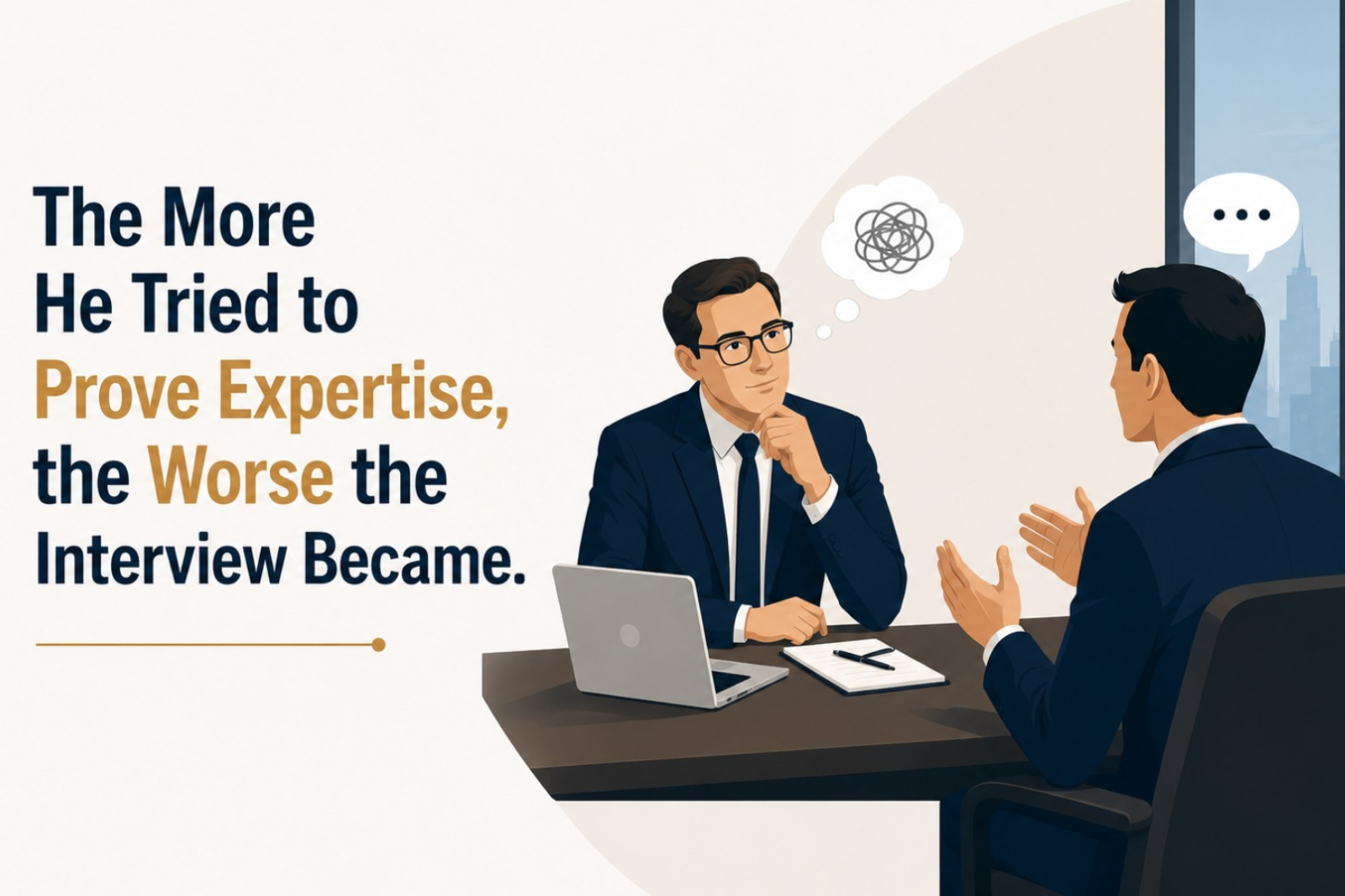
One of the most common patterns I observe in senior interviews is this: the moment experienced professionals start feeling the need to prove expertise aggressively, the interview often starts slipping quietly.
Not immediately. Not dramatically. But slowly, the energy inside the room changes.
The answers become longer. The explanations become heavier. The candidate starts adding more context, more technical depth, more examples, more justification. And strangely, the more they try to establish credibility, the less leadership confidence they create.
This confuses many experienced professionals because from their perspective, they are doing exactly what the interview requires. Demonstrating capability. Showing experience. Proving competence.
But leadership and senior-level interviews rarely evaluate only competence.
They evaluate clarity. Judgment. Communication maturity. Executive presence. The ability to think calmly under pressure. The ability to communicate direction instead of simply displaying information.
That changes the nature of the conversation entirely.
I remember observing a senior professional during a mock interview recently. Very capable. Strong industry background. Deep domain expertise. Someone who had clearly spent years handling large responsibilities and complex environments.
But after almost every question, he continued expanding the answer far beyond what was necessary.
A simple question became a five-minute explanation. A strategic point became a technical walkthrough. Every response carried an underlying need to ensure the interviewer fully understood the depth of his experience.
Initially, the answers sounded impressive.
But slowly, something started changing.
The room stopped experiencing him as strategic.
Not because he lacked capability.
But because the communication started feeling heavy.
The answers became informational instead of directional. Detailed instead of influential. Exhaustive instead of clear.
And this is where many experienced professionals unintentionally struggle.
Especially after 15–20 years of experience.
Because interviews at senior levels become psychologically different. Experience slowly becomes identity.
Which means interviews no longer feel like:
“Can I do this role?”
They start feeling like:
“Do they recognize the value of everything I have built over the years?”
That subtle psychological shift changes communication behavior significantly.
Professionals start over-explaining because they do not want their experience to be underestimated. They start adding excessive detail because they want credibility to feel undeniable. They begin defending decisions that were never even questioned. Sometimes they answer with urgency because somewhere internally, they are trying to protect years of professional identity inside a 45-minute conversation.
Ironically, these behaviors often reduce leadership perception instead of strengthening it.
Because senior interviews are usually not searching for the person who knows the most.
They are observing something deeper.
Who creates confidence in the room?
Who communicates clearly under ambiguity?
Who can simplify complexity instead of expanding it endlessly?
Who sounds calm while being evaluated?
Who thinks directionally instead of operationally?
Who sounds like someone capable of leading through uncertainty?
This is where the communication difference between experts and leaders quietly becomes visible.
Experts often feel the need to explain everything. Leaders usually communicate what matters most.
That does not mean leaders know less. In many cases, they know far more. But experience has taught them something important: clarity creates more confidence than excessive detail.
And many experienced professionals underestimate how strongly interview perception is shaped by communication energy.
A professional may have extraordinary expertise, but if the answers feel overly defensive, excessively detailed or difficult to follow, the interviewer slowly stops experiencing leadership confidence.
This is one of the reasons why some highly capable professionals still struggle during senior interviews despite impressive resumes and strong careers.
Not because capability is missing.
But because interview communication changes significantly at leadership levels.
Sometimes the strongest answers in interviews are not the longest answers.
They are the clearest ones.
Sometimes confidence is created not through explaining everything but through knowing what not to over-explain.
And this is precisely why practical interview preparation matters.
Because many interview mistakes are not knowledge problems.
They are perception problems.
Especially in senior and leadership conversations.
The Interview Room was created around these observations.
Not generic interview tips. Not polished career advice. But the real communication patterns, psychological shifts and evaluation moments that quietly shape interview outcomes for experienced professionals.
Because interviews are rarely only about expertise.
They are about how expertise is experienced inside the room.
One of the most common patterns I observe in senior-level interviews is this: The moment experienced professionals start feeling the need to aggressively prove their expertise, the interview often starts slipping quietly.
Not immediately. Not dramatically. But slowly, the energy inside the room changes.
The answers become longer. The explanations become heavier. More context gets added. More technical depth. More examples. More justification. And strangely, the more they try to establish credibility, the less leadership confidence they sometimes create.
This confuses many senior professionals because, from their perspective, they are doing exactly what the interview demands: demonstrating capability, showing experience, proving competence.
But leadership interviews are rarely evaluating only competence.
They are also evaluating: clarity, judgment, communication maturity, executive presence, and the ability to think calmly under pressure.
That changes the nature of the conversation completely.
I remember observing a senior professional during a mock interview recently. Very capable.
Strong industry background. Deep domain expertise. Someone who had clearly handled large responsibilities over many years.
But after almost every question, he continued expanding the answer far beyond what was necessary.
A simple question became a five-minute explanation. A strategic point became a technical journey. There was an underlying effort to ensure the interviewer fully understood the depth of his experience.
Initially, the answers sounded impressive.
But slowly, something started changing.
The room stopped experiencing him as strategic.
Not because he lacked capability.
But because the communication started feeling heavy.
The answers became informational instead of directional. Detailed instead of influential.
Exhaustive instead of clear.
And this is where many experienced professionals unintentionally struggle, especially after 15 or 20 years of experience.
Because at senior levels, interviews become psychologically different. Experience slowly becomes identity.
Which means the interview no longer feels like:
“Can I do this role?”
Somewhere internally, it starts feeling like:
“Do they recognize the value of everything I have built over the years?”
That subtle psychological shift changes communication behavior significantly.
Professionals start over-explaining because they do not want their experience to be underestimated. They add excessive detail because they want credibility to feel undeniable. Sometimes they begin defending decisions that were never even questioned. And sometimes, without realizing it, they answer with urgency because internally they are trying to protect years of professional identity inside a 45-minute conversation.
Ironically, these behaviors often reduce leadership perception instead of strengthening it.
Because senior interviews are usually observing something deeper.
Who creates confidence in the room?
Who communicates clearly under ambiguity?
Who can simplify complexity instead of expanding it endlessly?
Who sounds calm while being evaluated?
Who thinks directionally instead of operationally?
Who sounds capable of leading through uncertainty?
This is where the communication difference between experts and leaders quietly becomes visible.
Experts often feel the need to explain everything. Leaders usually communicate what matters most.
That does not mean leaders know less. In many cases, they know far more. But experience has taught them something important: Clarity creates more confidence than excessive detail.
And many experienced professionals underestimate how strongly interview perception is shaped by communication energy.
A person may have extraordinary expertise, but if the answers start feeling defensive, overly detailed, or difficult to follow, the interviewer slowly stops experiencing leadership confidence.
This is one of the reasons why highly capable professionals sometimes struggle in senior interviews despite impressive careers and strong resumes.
Not because capability is missing.
But because communication expectations change significantly at leadership levels.
Sometimes the strongest answers are not the longest answers.
They are the clearest ones.
Sometimes confidence is created not by explaining everything, but by knowing what not to over-explain. And this is precisely why practical interview preparation matters.
Because many interview mistakes are not knowledge problems.
They are perception problems.
Especially in senior and leadership conversations.
The Interview Room was created around these observations.
Not generic interview tips. Not polished career advice. But the real communication patterns, psychological shifts, and evaluation moments that quietly shape interview outcomes for experienced professionals.
Because these conversations are rarely only about expertise.
They are also about how that expertise is experienced inside the room.
Many senior professionals prepare by revising answers.
Very few prepare for the psychological shift that leadership-level conversations demand.
And often, that is where the real difference begins.
Note: I regularly make videos about how presentation clarity, communication, and influence shape careers and leadership conversations on YouTube (https://www.youtube.com/@SarabjeetPresentationCoach)