
A candidate once showed me a resume that was almost fourteen pages long.
He had nearly three decades of experience. So, on paper, there was plenty to talk about.
Except there was one problem.
The resume didn’t really sound like him.
It had all the right words. Leadership. Transformation. Navigating uncertainty. Strategic thinking. The kind of language we have all become used to seeing.
But when I was speaking to him, the person sitting across from me was very different from the person on those four pages.
That conversation stayed with me because, over the last few episodes of Observations from The Interview Room, I have found myself coming back to the same question: what are we actually trying to understand when we interview someone?
Because the more I speak to people who have spent decades hiring and leading teams, the more I realise that it is rarely just about whether a candidate can do the job. Once the basic competence is established, something else starts becoming important.
Mr. Shashi Sinha put it very simply. He told me that once skills have been tested, his conversations tend to move towards life values, relationships and the way people interact with others. Skills matter, but they are only one part of the picture. Character, interpersonal relationships and how someone behaves under pressure tell you something that a resume never really can.
When I asked Shashi what three qualities he would look for in a candidate, I expected the usual answers. Communication. Leadership. Problem-solving. Maybe something technical.
His answer was very different.
Trust. Alertness. And being well-meaning.
That stayed with me.
Because these are not things you can simply add to a resume. You cannot write “I am highly trustworthy” and expect the interviewer to accept it. You have to demonstrate it through your decisions, your stories, your relationships and the way you talk about your experiences.
And this is where my conversation with Mr. Marcel Parker took the discussion somewhere else entirely.
He told me that when he asks someone, “Tell me something about yourself,” he is often looking for something that isn’t written on the resume. One of the questions he sometimes asks is: “Describe to me how your spouse would describe you.” His reasoning is interesting. The spouse is one of the people in front of whom you don’t have a professional mask, so the answer can reveal something about the person underneath the carefully prepared interview version.
I remember stopping at that question.
Because suddenly, the candidate cannot hide behind titles and achievements.
You have to think about yourself as another person sees you.
And that, I think, is the real challenge with interviews today. We are getting better and better at preparing the professional version of ourselves. We know what words to use. We know what sounds impressive. And with AI, it has become even easier to create resumes and answers that look polished.
But polished is not the same as credible.
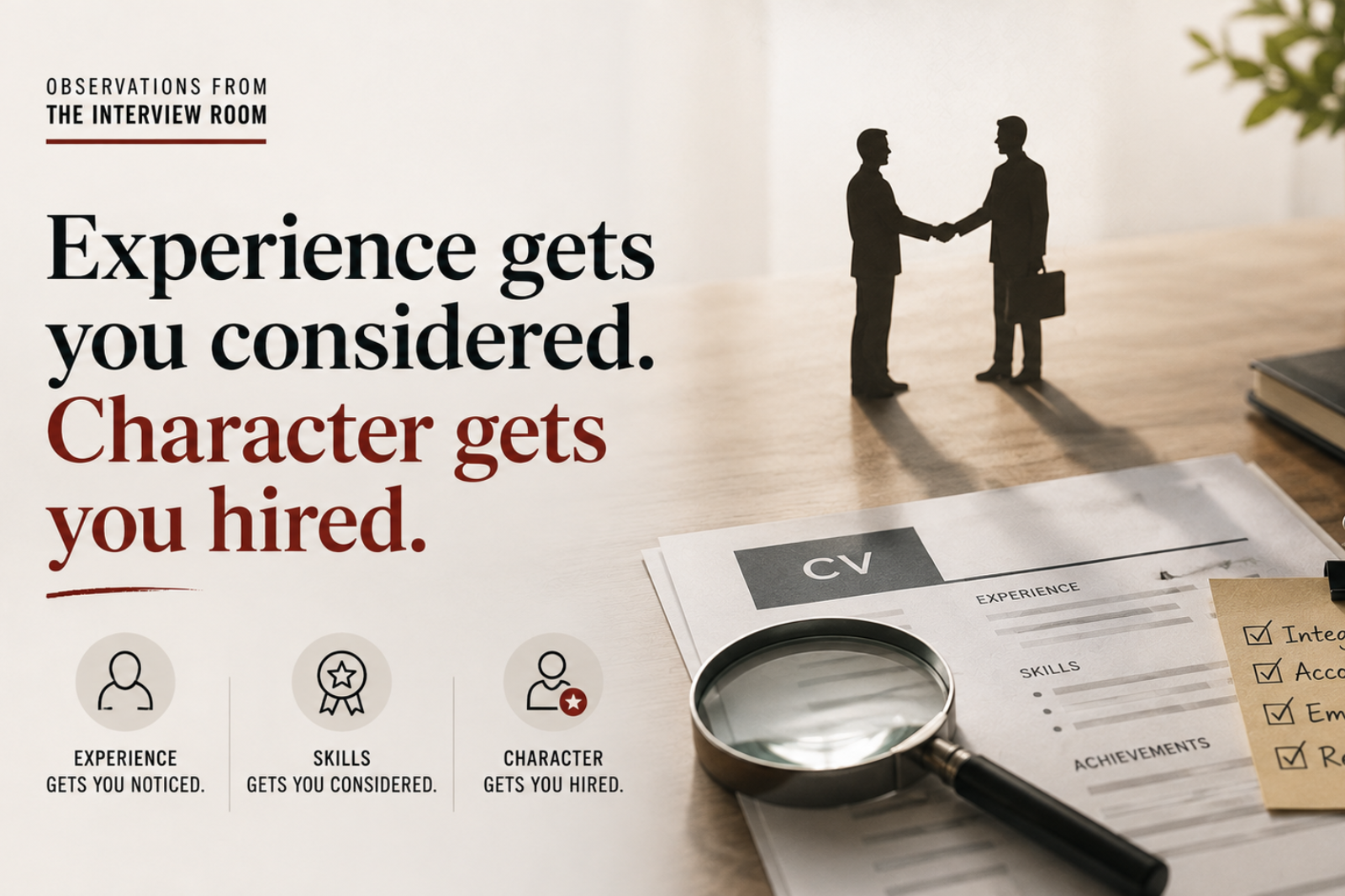
Marcel made this point very clearly: AI can help create a resume, and a resume can help you get noticed, but the resume does not get you the job. The interview does.
That is also why I think experienced professionals sometimes prepare for interviews in the wrong way. They keep improving the document when they should perhaps be spending more time understanding the person the document represents.
And then there is another layer to this.
Culture.
A technically excellent candidate can still be the wrong hire if the way that person works does not fit the organisation. Marcel described culture as something much harder to define than competence. It is, in many ways, the way things are done around here. And one of the ways he tries to understand that fit is through behavioural questions, because there is rarely one perfect answer. You are trying to understand how the person thinks, reacts and behaves.
That made me think about what hiring managers are really doing when they interview.
They are not simply checking whether you know something.
They are trying to imagine what it will be like to work with you.
Can I trust this person? How does this person behave with others? How do they respond when things don’t go their way? What happens when they make a mistake? Who are they when nobody is watching?
A resume can tell someone what you have done.
It can get you noticed.
It can get you into the room.
But once you are there, the document has done its job.
The person now has to take over.
And perhaps that is where we should spend more of our interview preparation time not polishing the resume endlessly, but making sure that when the interviewer puts it aside, the person sitting across the table is someone worth remembering.
Podcast episodes link: https://www.youtube.com/playlist?list=PLjdGjWo1xZSJ_jHJoEY721HzsrFS8tq3S