

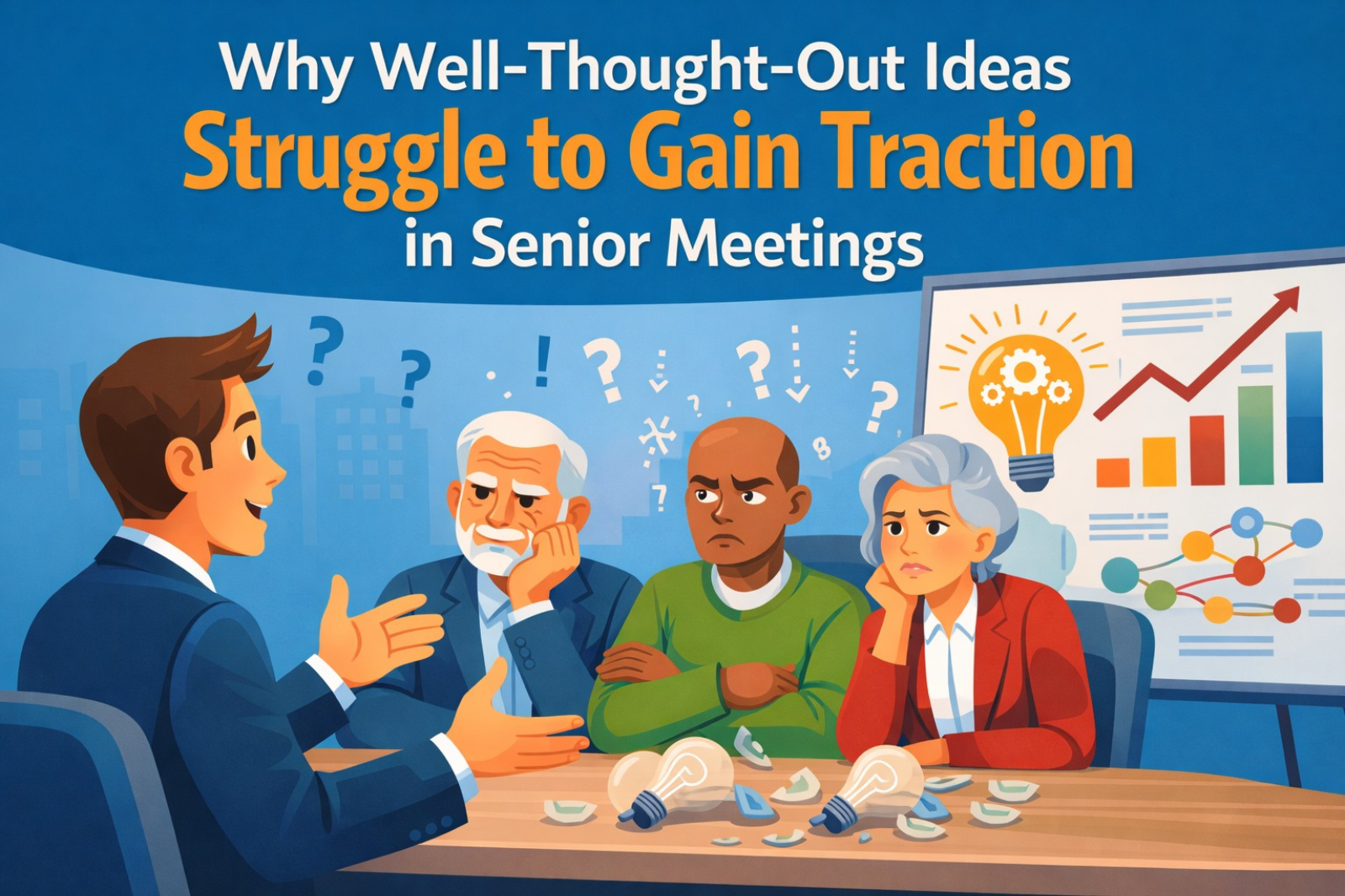
A senior professional once described a leadership meeting where he presented an idea he had been refining for weeks. It was grounded in data, informed by experience, and carefully thought through. The room listened. A few people nodded. There were clarifying questions. No objections.
And then the meeting moved on.
No resistance. No decision. Just polite acknowledgement and a shift to the next agenda item.
This is how many strong ideas fail, not through rejection, but through quiet irrelevance.
Senior meetings operate under constraints that are rarely acknowledged openly. Time is compressed. Attention is fragmented. Decisions carry consequences far beyond the room. In this environment, ideas are not evaluated only on their merit, but on how clearly they help the room move forward.
Well-thought-out ideas often arrive as explanations. They describe the problem comprehensively. They lay out context, risks, and possibilities. The intent is to be responsible and thorough. The unintended result is that the idea remains open-ended.
Senior audiences are not looking to explore indefinitely. They are looking to resolve.
When an idea does not create a clear direction, when it does not clarify what choice is being proposed, it becomes difficult to act on. The idea may be sound, but it does not anchor a decision.For example as a project head you may have an idea to improve the process which will help in reduction of the timeline while maintaining the quality. But you may miss out that stakeholders will resist it as it increases their co-ordination workload. So unless you present how the idea will be managed, resolving the stakeholder resistance, it will not cut any ice.
This is where many capable professionals get confused. From their perspective, the thinking was solid. From the room’s perspective, the idea did not answer the most pressing question: What do we do with this now?
Traction is not about agreement. It is about movement.
One important step that most miss out is bounce off the idea with a small trusted group or an individual to see if it is aligned to the purpose. The feedback (discussing pros and cons), before you present it, can help you refine it. Ideas gain momentum when they help others prioritise, when they reduce complexity rather than expand it. When they signal what matters most and what can wait. When they transform information into intent.
This is not about oversimplifying. It is about orientation.
Without orientation, even strong ideas remain optional. They are acknowledged, appreciated, and then set aside.
Ideas struggle in senior meetings not because they are underdeveloped, but because they arrive without a clear path forward.
Note: I write regularly about how presentation clarity, communication, and influence shape careers and leadership conversations.
If you’d like to read more and get these pieces in your inbox, you can send us your email id to subscribe for the below newsletter:
https://sarabjeetsachar.com/presentation-influence/